
I’m having lots of Eye of Sauron moments as I learn more about glucose, metabolic disease, and metabolic dysfunction. It’s not pretty, and at times, I’m in tears, thinking about signs of bad health I missed over the years.
Recently, I saw my general practitioner (Dr. Laura). I knew there would be some bloodwork involved.
For the first time in my life, I deliberately fasted, even skipping my regular black coffee that morning so that I could get a true fasting glucose level.
What’s considered normal? The normal range for fasting glucose is from 60 to 100 mg/dL.
For the last few years, I’ve tested on the higher side of normal (between 93 and 99), but as I said, its the “fasting glucose” they are measuring, and I’ve never done bloodwork when fasting.
It’s never been articulated to me that I really should fast before bloodwork. No one has ever said, “When was the last time you ate or drank anything other than water?” Neither a doctor nor the phlebotomist, as they get ready to take my blood sample.
It wasn’t until 2023 that ANY doctor looked at my glucose level and said, “That’s high. You should pay attention to your sugar intake.”
(And that’s when I quit Cheerios, months before getting diagnosed with CLL.)
But of course, our health is in our own hands. It was probably right there in 6 point light gray type on the back of the form.
So, back to the present. Last week, I was thrilled to see that my fasting glucose was 88! Wow!! I’m fixing my metabolism! I patted myself on the back.
Dr. Laura decided to also do a hemoglobin A1C test, which took a few days longer to show up in my chart. I’ve never had one before. The CDC currently recommends that everyone over 45 should have one, and that anyone who is overweight or showing signs of diabetes should have one, regardless of age.
Well, my results show that I’m just over the top range at 5.8%, which is pre-diabetic.
What’s considered normal? The normal range for hemoglobin A1C is between 4.2% and 5.6%. The diabetic range begins at 6.4%.
So, yeah. That took a few days to digest. I do struggle with this news because I have eliminated ALL processed foods and sugars from my diet for over a year now. Even before that, I rarely drank a soda or any type of alcohol. I would have described my diet as healthy.
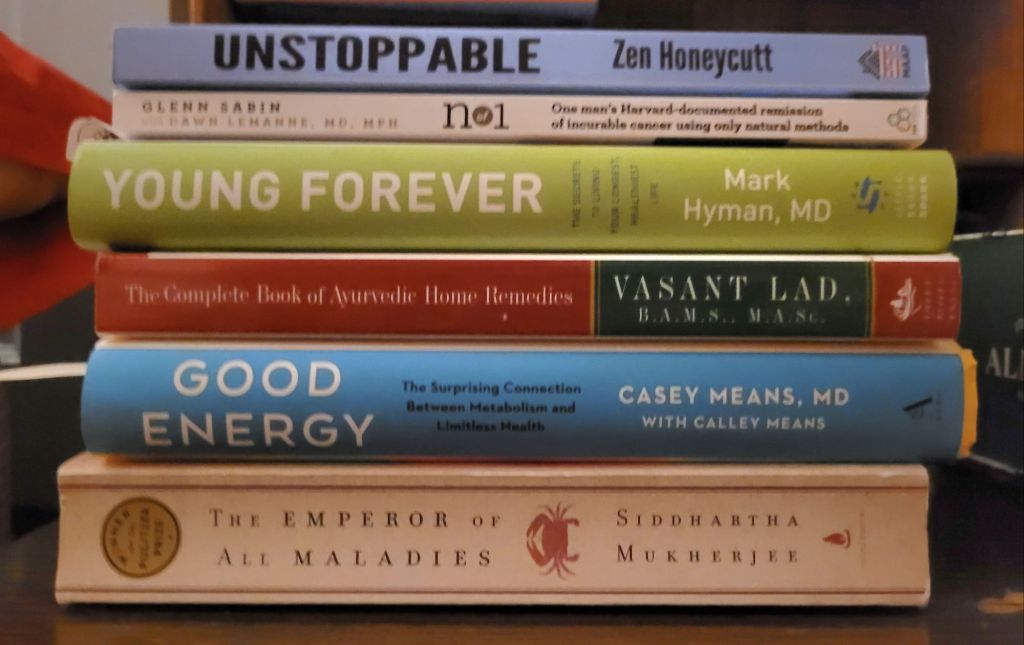
I’ve been reading Good Energy by Dr. Casey Means, and I remembered a section on these sorts of metabolic biomarkers.
I found and re-read those pages. She calls for lower averages on almost all of the metabolic markers than the current standards.
Here’s how she starts: “… we have all nodded as doctors quickly glossed over test results, but very few of us have any idea what these numbers mean.”
Boy, howdy!
She defines “fasting” as 8 hours without eating or drinking any calories and sets a range of 70 to 85 mg/dL as the optimal range for fasting glucose.
She also lists 5.0% to 5.4% as the lowest risk range for hemoglobin A1C.
So, beyond sugars and processed foods, the next thing I need to look at is my carb intake. That’s the potatoes, pasta, rice, oats, and other grains that make up so much of our diet.
Good luck to me (and all of us) on Thanksgiving! Gobble gobble!
I also found this episode on one of my favorite podcasts, Diary of a CEO.
The Glucose Goddess, Jessie Inchauspé, has so much to teach us!
She told a quick story about a man who read her book. “There was this one guy, he had diabetes his whole life, he’s in his 50s, on lots of medications, and just thought he would lose a leg, or lose his vision… that’s what happens when you have type 2 for a very long time… and his doctors had never explained to him WHY he had diabetes, they had just told him ‘take this pill’ and ‘take this insulin’… and, he read my book, and he understood why he got diabetes in the first place, and he did the hacks. He was able to reverse his type 2 diabetes in one year. All his doctors were like, “How did you do it?” … you know, doctors don’t often have this information…”
Here are a few positive steps or “hacks” shared in the episode:

- Eat a savory breakfast. This means eating protein, fats, and NOTHING sweet. (She suggests eggs, meat, tofu, nuts, and dairy, or leftovers from dinner). When you have sweets for breakfast, she warns, you set yourself up for a day of sugar spikes and crashes.
- Vinegar once a day. 1 tablespoon in a glass of water 10 minutes before your biggest meal. It interacts with your digestive enzymes and keeps you from having a glucose spike. Dilute it with water so it doesn’t hurt tooth enamel.
- Veggie starters are vegetables eaten at the beginning of a meal. This puts fiber into your intestines before the rest of the meal, slowing the absorption of glucose into your system. Combine with hack 2 for a pre-meal salad.
- Exercise after eating. Just light activity is fine. Walk the dog. 10 minutes is all it takes. Calf muscles soak up glucose more than any other muscle in the body.
I’m off to get a copy of her book to add to my nightstand collection. 📖
 The Cancer Canary