Read this today and wanted to share.
It would have made a great chapter in The Emperor of All Maladies…
Read this today and wanted to share.
It would have made a great chapter in The Emperor of All Maladies…
Came across this recipe, which promises cancer-fighting properties. It was developed by Johanna Budwig, a German biochemist and pharmacist who developed a lacto-vegetarian cancer prevention diet in the 1950s.

Not gonna lie, flaxseed oil tastes pretty yucky. It literally tastes like you are eating oil paint. BUT it contains a lot of omega 3 fatty acids, which most of us are not getting enough of.
Mixing with cottage cheese somehow helps aid in the digestion of the flaxseed oil. It has a symbiotic effect.
She passed away in 2003, a few years before the discovery of resolvins and protectins:
Only recently has it been established that inflammation resolution is an active process with a distinct set of chemical mediators. Several clinical and epidemiological studies have identified beneficial effects of polyunsaturated fatty acids (PUFAs) for a variety of inflammatory diseases, yet without mechanistic explanations for these beneficial effects. Resolvins and protectins are recently identified molecules that are generated from Omega-3 PUFA precursors and can orchestrate the timely resolution of inflammation in model systems.
https://pmc.ncbi.nlm.nih.gov/articles/PMC2785519/
I do see this in relation to the seed oil info I posted earlier today. If modern man is living in an omega 3/ omega 6 imbalance, and we don’t know about it or understand the damage it is doing to us…. well, that’s a bad thing.
It’s interesting that Dr. Budwig’s daily regimen begins with sauerkraut juice… the kombucha of 1800s Germany.
Then she blends together flax seed oil (very high in omega 3s) with a dairy product to help it be absorbed easily.
I think the science will catch up to her and what she was able to do… reportedly nurse cancer patients back to health with nutritional strategies.
This video is already three years old, but worth a watch:
The Warburg Effect is the basis of the research into the new(ish) theories around treating cancer as a metabolic disease, as well as much of the research on fasting and its benefits.
I’ve been reading this book for a few months now.
Since my job is somewhat reading-intensive, I usually opt out of reading on weeknights.
Since my job is also rather sedentary, I opt out of reading much on the weekends.
So, it’s taking a long time to get through it.
There are also some very heavy topics here, and sometimes I just have to rest.
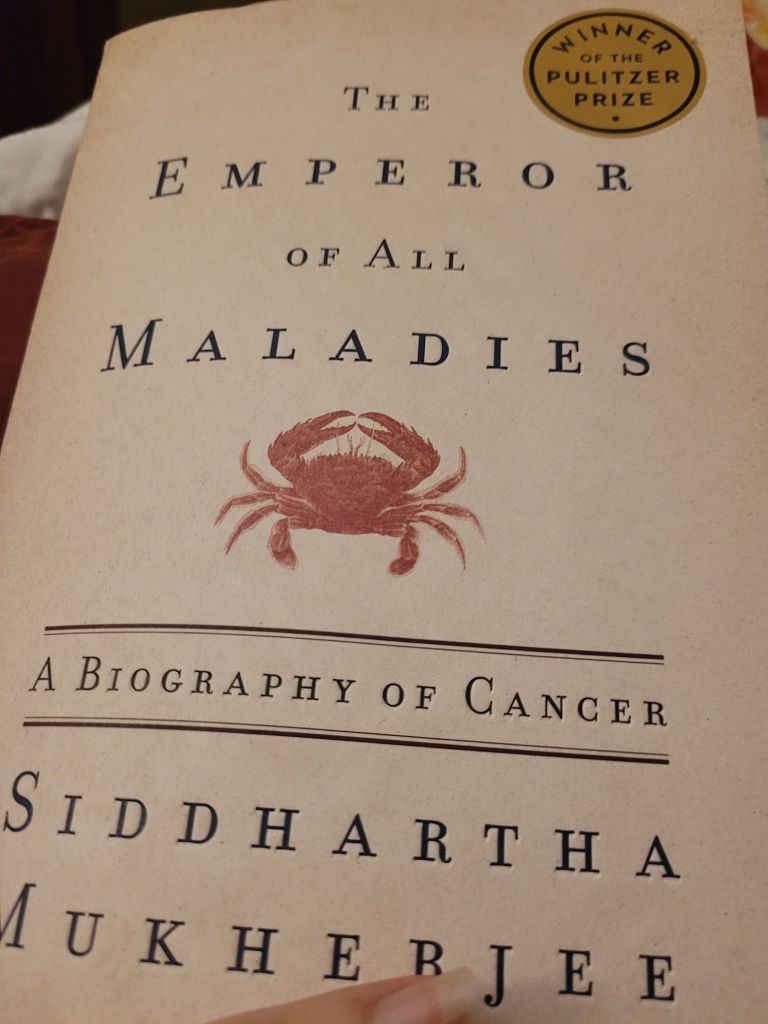
The other day, I got a notice from the library saying that a book I had put on hold was now ready for me. It was this very book! I laughed a bit. Then I looked a little closer and saw that it was an audio book. Oh yeah! I forgot!
So this evening, I’m on my rebounder AND reading. 😊 📖
The Emperor of All Maladies is the history of our struggle against cancer… to recognize, categorize, and organize against it.
It’s the story of Sydney Farber and many doctors who came since, each with their own focus and theories.
It’s the story of men and women who attack the problem with enthusiasm and tenacity, who often meet with scorn and disapproval… until the evidence they find is too great to be ignored.
It’s the story of thinkers who become obsessed and push their research too far, are sometimes demoted or fired. But regardless, their research had a lasting impact.
It’s a story where trials have promising results, but turn out to be misleading due to bias, or fraud.
It’s a story of public communications, advertising, and fundraising.
It’s the story of those who experiment on themselves.
It’s a timeline of assumptions that are accepted for decades… and then proven false.
It’s a story where “anecdotal” evidence is laughed at, then studied, then blocked for decades from reaching the ears of the common man, who continues consuming the dangerous product.
It’s very long, and since it was published in 2010, it does not contain a lot of new research and therapies. But still, I highly recommend reading it.
Siddhartha Mukherjee, the doctor who wrote it, is very insightful and also a great writer.
I recommend Mukherjee’s book The Song of the Cell to anyone trying to get a handle on all the amazing activities carried out inside us. It is really fascinating stuff!
And also, I recommend this article (which comes with an audio option) on how sometimes the beginnings of cancer (oncogenesis) is caused by more than one factor: https://www.newyorker.com/magazine/2023/12/18/all-the-carcinogens-we-cannot-see

Dear Lord, please protect this man. 🙏 amen!
As more and more physicians begin to understand the correlation between mitochondrial dysfunction and diseases such as cancer (and diabetes and dementia, and possibly others), I’m positive that some good things will happen.
One exciting thing is that, with the use of continuous glucose monitors, more and more people are able to see how their food choices impact this process, and then make better food choices.
Another exciting thing is that people are becoming aware of the issue and switching to ketogenic diets, which could reverse diabetes or manage (slow) the progression of cancer.
A new theory of cancer origin was recently introduced. It’s called the mitochondrial-stem cell connection (MSCC) (Martinez, et al., 2024). It builds on two other theories: Dr. Seyfried’s metabolic theory and the cancer stem cell (CSC) theory. I’ll put a link at the bottom if you want to learn more about that. I should mention that Dominic D’Augustino is one of the “et al.”
The exciting thing about this paper recently published on MSCC is that it proposes FIXING the underlying issue rather than focusing on killing cancerous cells.
In the past, most cancer therapies were built on the notion that cancer was genetic… it happened to those who were genetically predisposed to it… and the assumption was that to fight it meant to kill the cells, cut them out, radiate them, etc.
You could say that current cancer treatments are like playing whack-a-mole in an arcade. This new paper suggests we stop wracking the moles and simply unplug the machine from the wall.
Here are some excerpts. I will link the full paper below.
● This connection between CSCs and mitochondria appears to be crucial at all stages of cancer (Martinez, et al., 2024).
● These (standard) therapies do not restore OxPhos and sometimes even alter it (Averbeck & Rodriguez-Lafrasse, 2021; Gorini, et al., 2018). Furthermore, standard therapies only target bulk cells but cannot target cancer stem cells (Lytle, et al., 2018), whereas it is cancer stem cells that have the strongest tumorigenic potential (Adams & Strasser, 2008) and are involved in metastasis.
● Thus, after reviewing the literature on various therapies capable of targeting the MSCC, we selected, based on in vitro and in vivo studies, several orthomolecules, drugs, and additional therapies that have demonstrated an ability to enhance OxPhos, reduce fermentable fuels, and target CSCs and metastasis. Furthermore, when supported by scientific literature, we included case studies of cures using monotherapy in humans. From this combination, we developed a hybrid orthomolecular protocol, which is proposed as a new therapeutic strategy for cancer.
• The degree of malignancy could be directly correlated with significantly lower mitochondria and lower total respiratory capacity in tumor cells (Elliott, et al., 2012; Pedersen, 1978; Seyfried, et al. 2020).
• In order to grow and survive, cancer cells require the primary fuels glucose and glutamine to compensate for OxPhos insufficiency. The respiratory impairment induces overexpression of oncogenes and inactivation of tumor-suppressor genes, which contribute to abnormal energy metabolism in cancer. To date, no evidence has demonstrated the growth of any tumor cells, including CSCs, occurs with the deprivation of fermentable fuels (glucose, pyruvate, or glutamine) (Lee, et al., 2024; Liao, et al., 2017; Holm, et al., 1995; Mathews, et al., 2014; Pastò, et al., 2014).
📖
Read the full paper on MSCC:
Read more about cancer stem cell theory:
 The Cancer Canary