Homemade Granola

The house smells wonderful this morning as I’ve made a batch of homemade granola. It’s delicious and also good to know all the ingredients are whole foods from sources I’ve scrutinized myself.

Including the chia and flax seeds is a way to add Omega-3s into my diet. Using coconut oil helps reduce my Omega-6 load because even organic granola includes seed oils.

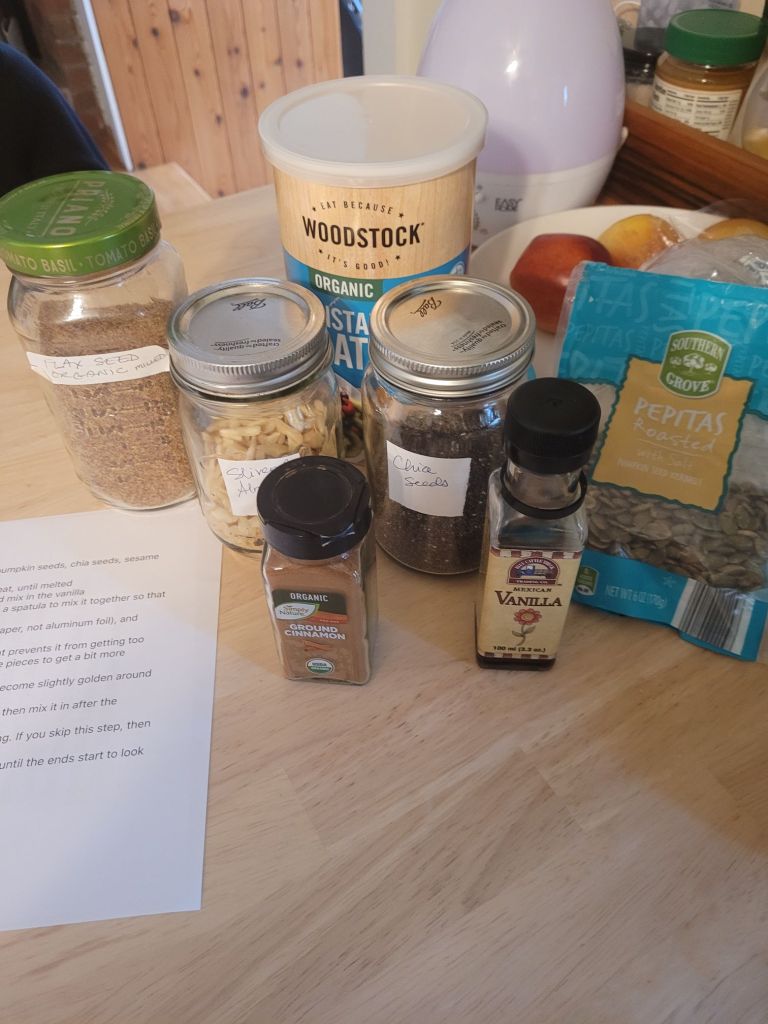
Im using a recipe titled “Maple and Chia Seed Granola” by Maria Provenzano, changed a bit based on what we had in the cupboard:

  • 4 cups old fashioned oats
  • ½ cup slivered almonds
  • ¾ cup pumpkin seeds
  • 2 tablespoons chia seeds
  • 2 tablespoons ground flax seeds
  • 1 tablespoon sesame seeds
  • 1 teaspoon cinnamon
  • ½ teaspoon salt
  • ½ cup pure maple syrup
  • 1 teaspoon vanilla
  • ½ cup coconut oil, measured then melted
  • 1/2 cup shredded coconut
  • 1/2 cup dried berries and/or raisins
  • 1/4 cup dried apricots, diced into small chunks

Preheat the oven to 325 degrees.


In a large bowl, combine the oats, slivered almonds, pumpkin seeds, chia seeds, flax seeds, sesame seeds, cinnamon, and salt until well mixed.


Melt the coconut oil in a small pan over low/medium heat until melted. Combine the coconut oil and maple syrup together, and mix in the vanilla.


Pour the oil/syrup mixture over the oat mixture, and use a spatula to mix it together so that everything is evenly coated.


Line two baking sheets with parchment paper (not wax paper, not aluminum foil), and evenly distribute the granola between the two sheets.


Keep the granola somewhat compact, because that prevents it from getting too crunchy; it allows the center to stay chewy, and the outside pieces to get a bit more crunchy.


Bake at 325 degrees for 12-14 minutes, or until starting to become slightly golden around the edges. Don’t bake longer than 14 minutes.


Allow the granola to cool for at least 10-15 minutes after baking. If you skip this step, then the granola won’t come together.


After it has cooled, add in all the extras like coconut flakes and dried fruit.


Put it in a good jar with a tight-fitting lid.


Here’s the original recipe: https://www.fromscratchwithmaria.com/maple-chia-seed-granola/
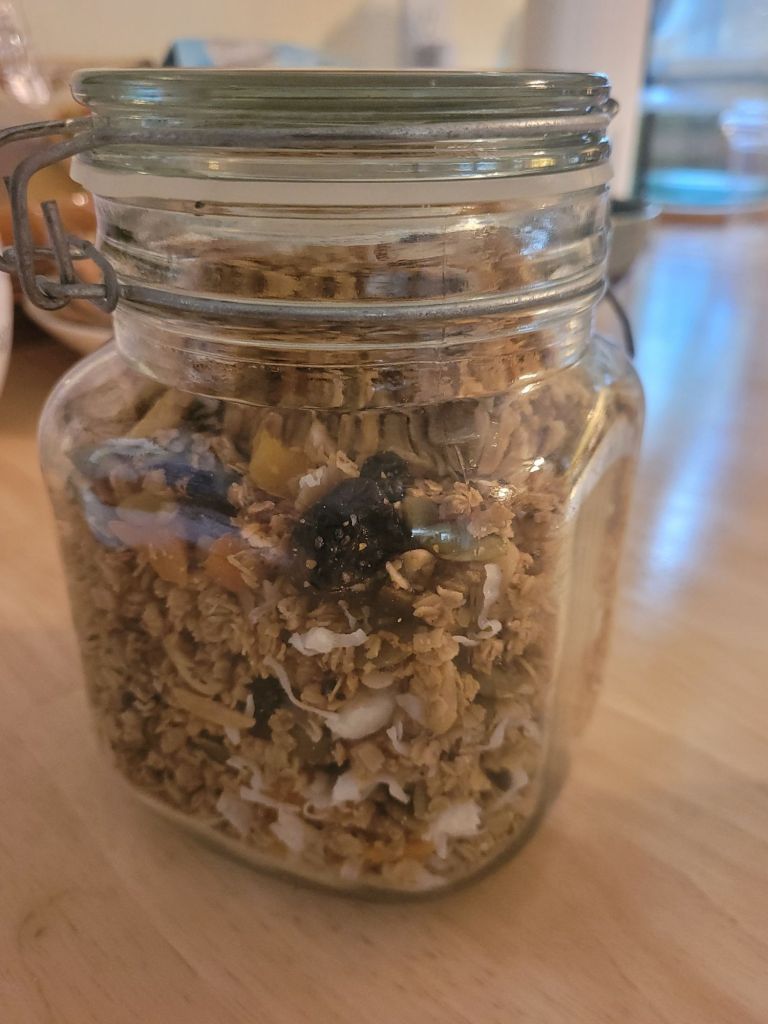

Yum! It’s half gone already.

Google

The first thing I did after reading my diagnosis was to Google this particular type of cancer I have. I’d never heard of CLL before!

Immediately, I found that it is linked to glyphosate, also known as roundup. Of course, I knew roundup was not good — for people and bees and Monarch butterflies… for the environment in general.

I had avoided it, never purchasing it for my own yard. How could I have a disease caused by something I’ve always avoided?

Back to the Google search bar… this time to search for foods with glyphosate residue. Number 1 is Cheerios. Well, I’ve eaten a bowl of Cheerios for breakfast for many, many years! Damn. And here I thought it was a healthy choice!

Also on the list, Nature Valley Granola bars. I bought those hundreds of times, a lunch box staple for the kids… and it’s poison. Friggin poison.

I’m going to stay positive and just say, for now, please be aware that mainstream food sources carry a heavy pesticide/herbicide load and many of these chemicals have links to cancer and other chronic diseases, such as Parkinson’s. I’ll write more in the future… but for now I just want to say a couple of things:

● Many chemicals are used in industrial farming, which is the source of all processed foods. In the US, these chemicals are “innocent until proven guilty,” meaning that they can be used until they are scientifically proven to cause harm. In many other countries, chemicals are “guilty until proven innocent,” resulting in a much healthier population.

Organic food can be more expensive but it is worth it. Aldi and Trader Joe’s are great places to explore, and the prices are pretty good.

Many imported foods are free of glyphosate and adhere to higher food safety and quality standards. Find yourself a good Italian grocer and look for “Made in Italy” on the label. Aldi carries many “Made in Germany” items, especially in October, and some imported pastas from Italy.

● Find a local farm or farmer’s market, ask them how they farm and what pesticide/herbicide/fertilizer they use, if any. Find someone you know and trust, and then support them with the money you used to spend on processed food.

● Glyphosate is used as a drying agent for foods when they are harvested. So, at the moment of harvest, a big dose is sprayed on foods like oats, wheat, beans, legumes, etc. This keeps harvested food from becoming moldy. Did you know this? I didn’t.

● I really wish I could travel back in time and stop eating Cheerios and other non-organic foods, but I can’t, so I’m telling you, in the hope that you can avoid my fate.

Changing your food sources is a very big step in defensive living… what you eat is really what you are, on a cellular level. You and your family are WORTH IT!