Long Time, No Write

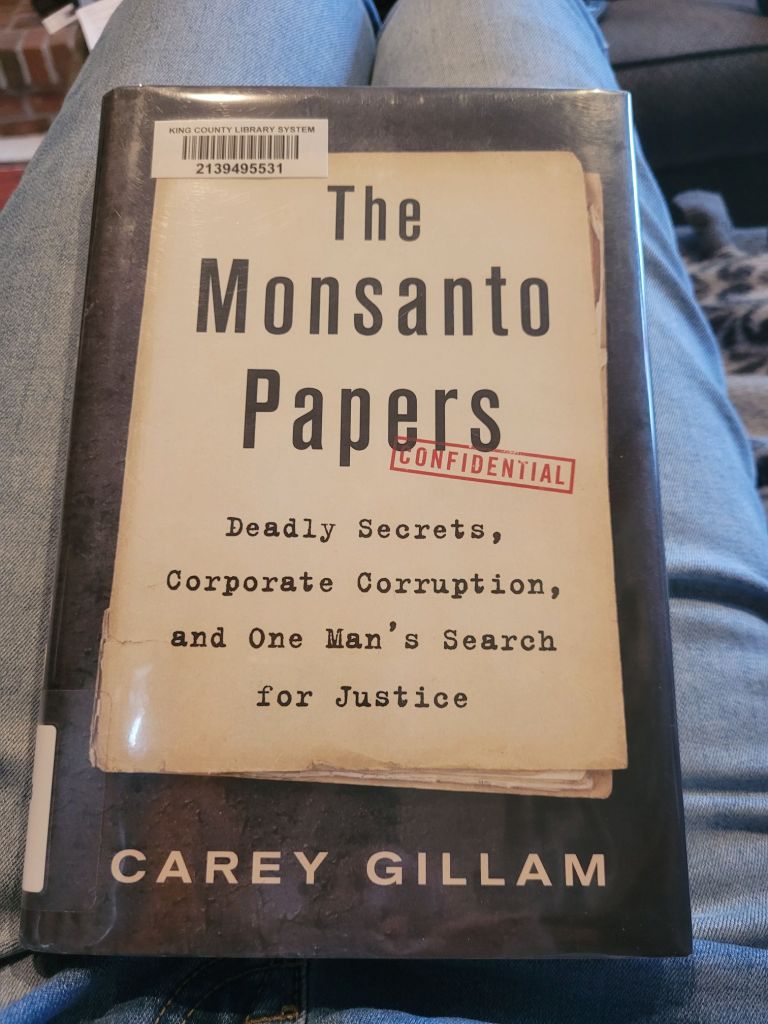
I’ve been traveling a bit, down to Florida, to see family and work on our old house. Along the way, I’ve been reading The Monsanto Papers by Carey Gilliam.

This is the story of the lawyers who took on Monsanto, the plaintiffs they represented, and many internal emails and documents from within Monsanto that were shared with the public in 2017.

There are parts of this book that made my mutated blood boil.

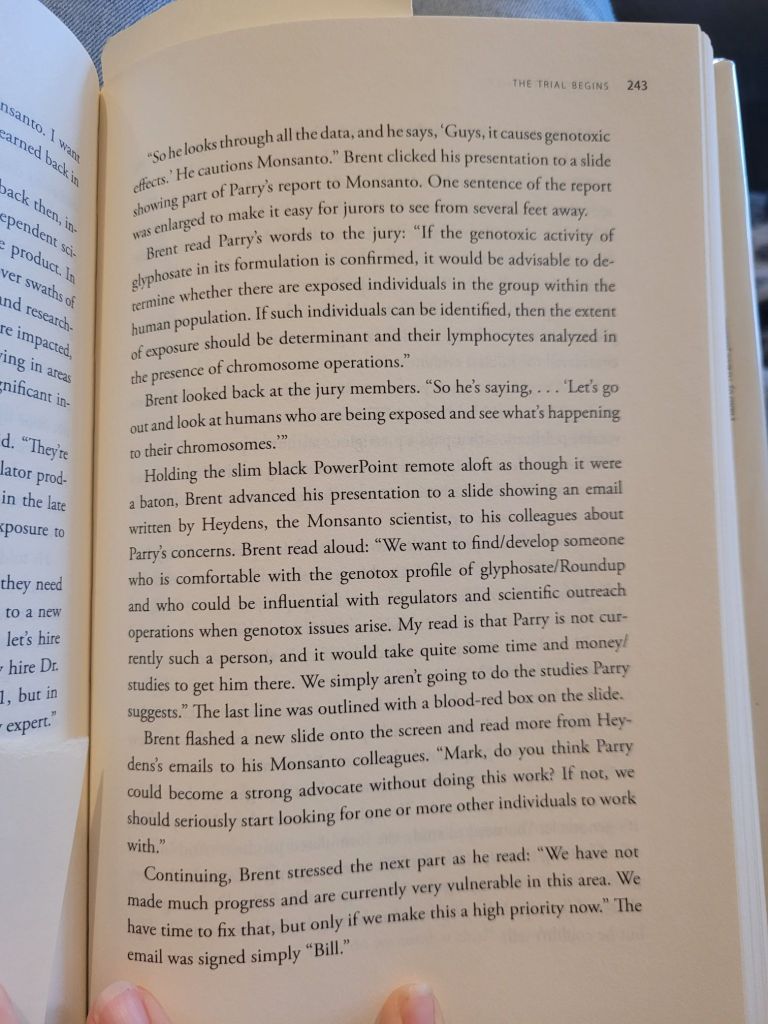
For example, this passage from page 243. This is text from the court testimony of Dewayne Johnson vs. Monsanto Company, showing internal an email from Dr. James Parry,  indicating not only that the company knew – in the 1990s – that glyphosate caused cancer, but that they knew to look for mutations of the lymphocytes.

They already knew which cell would be affected first.

Even though the plaintiff won his case, and even though more and more cases came to trial, and even though there was a flurry of publicity surrounding each one… glyphosate is still the most used herbicide on the planet.

It’s still used as a desiccant during harvests.

And it’s still in most foods you can buy in any American supermarket.


If you’d like to know more, there’s a film called Into The Weeds which shows scenes from the courtroom. You’ll get to know Dewayne Johnson and hear and see his heartbreaking story. The film can be streamed for $2.99 through Amazon.

Carey Gilliam has written a few other books on this topic, and there are some interesting interviews with her on YouTube.

https://www.intotheweedsimpact.com/

It will make you sick, literally and figuratively.

Symptoms

In 2018, we moved from Florida to New York. A lot of things changed, from the water to the weather, the pollen, the food, the amount of sunlight, noise levels, stress levels … everything, really.

I started getting what I now call “6 hour colds” in the spring of 2019. I’d feel a tickle in my throat or cough or sneeze, go take a nap, and then wake up feeling fine. I wouldn’t get sick… not for more than 6 hours anyway. It was weird, but really, I didn’t think about it much. Whos going to complain about not getting sick?

I also started to notice that, after a lifetime of asthma, hay fever, and allergies, mine had gone away. In Florida, I could go through a jumbo box of Kleenex in a couple of days. In New York, my husband and son were having allergies, which they rarely had in Florida, and I wasn’t. Hmmm. Must be different pollen...

I mentioned earlier that I do some work for the American Lung Association, and a lot of it involves asthma training. I remember arguing over whether asthma was a chronic condition. I thought it wasn’t because, evidently, I had “outgrown” mine.

In early 2020, well, you know what happened. Covid! My family got it, but I didn’t. Hmm… I must be lucky, or maybe I’m one of those asymptomatic carriers.

In 2021, I went hiking with my kids at Letchworth Park, the “Grand Canyon of the East.”  It’s a beautiful place, and you should definitely check it out if you get a chance. We parked at the upper falls and walked down steep stone stairs to the middle falls, maybe a distance of a mile or so, mostly stairways but some flat land, too. I was fine on the way down. Getting back to the car was a real challenge, though, because those stairs were steep!

I was getting winded very easily and had to stop a few times. I had never felt like that before. When we got back up to the car, I let my daughter drive. I was too shaky and lightheaded to do it. I recovered after a bit of rest and was fine.

Later, knowing that I needed to get some exercise and build up my stamina, I joined a gym and started doing zumba and yoga regularly. Those hour-long classes never took me to that place of exhaustion I felt at Letchworth.


There were other odd occurrences, and I don’t know if they were symptoms of CLL or not.

It seemed like my hair was thinning, but then again, I was going through menopause and that’s fairly typical.

I gained weight and had less energy in the evenings, but that sounded like menopause, too.

Sometimes, usually after walking up 2 flights of stairs, I would see blue spots. When it happened, I’d just drink a big glass of water. I had never been in an environment like this before, with the heater on 5+ months of the year and a potbelly stove in constant use. It made sense to chalk it up to simple dehydration.

I smelled different, not in a gross way, but just different, more acidic. It motivated me to exercise more and sweat more. I also started going to a sauna in the cold part of the year, approximately once a month.

My armpits were puffy, which could have been from the weight gain.

In December of 2022, I got a mammogram, which revealed an enlarged lymph node in one armpit. It was monitored with ultrasound a couple of times in 2023 and seemed to be slowly growing.

So we did a biopsy, which revealed cancer markers. Then, a battery of blood tests to confirm the diagnosis.

And here I am…
What is CLL?

My cousin asked me some questions about CLL this weekend, and it took me a while to recall the answers.

I realize that I’ve been focusing on lowering my toxin load and risk factors and healing my metabolic functions (a positive thing for me, my family, and hopefully you, too) instead of focusing on my disease (a negative thing that I can’t change).

Which is actually good from a stress-management perspective. 🧘‍♀️


Chronic lymphocytic leukemia is a cancer of the B cells, which are a type of white blood cell.

“Chronic” indicates that it is a lifelong condition, with no known cure.

“Lymphocytic” means that it involves a particular type of cell called the lymphocyte.

There are two main types of lymphocytes: B cells and T cells. B cells produce antibodies to attack bacteria, viruses, and toxins, while T cells destroy cells that have been taken over by viruses or become cancerous.

CLL is a dysfunction of the B cells.

“Leukemia” is a word for cancer of blood-forming tissues, including bone marrow. The word “leukemia” literally means “white blood” in Greek.


This is how CLL was explained to me by my doctor:

When a healthy person gets sick, the body sends out a variety of white blood cells to fight off the infection.

Some white blood cells are like army infantrymen — they go where they are told and do what they are told to do in order to fight the invader.

The B cell is like a Navy Seal. It goes in and locates the virus or germ, then rapidly tries a variety of ways to kill it. Once it succeeds in killing the invader, it sends a signal to the bone marrow, saying, “Make a million more cells that can kill the invader this way.” These cells are called activated B cells.

Once the invader is killed off and the virus or germ is conquered, there should be a signal that says a couple of things.

(I believe these are all sent by the B cell, but I’m not 100% sure.)

1. Thanks, bone marrow. You can stop making the activated cells now.

2. Thanks, activated cells. You can die off now. (This is called apoptosis, or “programmed cell death.”)

3. Thanks, immune system. You can relax now.

4. Let’s make some antibodies for future use.

So, in a person with CLL, these signals stop being sent. The activated B cells flood the bloodstream, and they don’t die off.

The very worst, most life-threatening part of having CLL is that those new antibodies are not being made. Thankfully, you still have the old ones that your body made when the B cells worked well.

My doctor told me that his little department of the cancer center lost the most patients during the covid pandemic, because this was a “novel” virus and most of them didn’t have antibodies similar to what was needed to fight the disease.

Another bad thing is that once you have CLL, you are more likely to develop another cancer. (It is closely correlated to skin cancer in men and women, and prostate cancer in men.)

The best thing about CLL is that it progresses very slowly. So you have a lot of time to make changes and figure things out.