I’ve learned a lot about diet and nutrition since being diagnosed, but I hadn’t looked at the brain health/mental health aspect until recently.
Side note: A few weeks ago, I came across a mention, from a researcher I very much admire, that the ketogenic diet didn’t seem to have much of an effect on cancers of the immune system. So, briefly, I have “normalized my relationship with carbs,” and while it sure tastes good, I can feel a sluggishness taking over. Gotta get back on track.
The almighty algorithm put this video in my path today, and I am glad to see it. I’m amazed to find so much overlap with what I have learned about eating for cancer management and physical health.
You need to sweat. Every day. Sweat cleans out your systems and allows toxins to leave your body.
I live in a cold place, and sweat is hard to come by for about half the year. So once a month or so, I treat myself to a 30-minute sauna.
It feels wonderful.
I usually have to take a break halfway through, just open the door and let some heat out and room-temp air in.
The place I go to has private rooms, some quite large to accommodate multiple people or a wheelchair or walker.
There are also rooms with cold plunge tubs. I haven’t tried that yet. 🥶
A really nice feature of this sauna studio is that they give you a cold towel with a menthol/camphor oil in it to wipe down as you sweat. So refreshing!
The first time I went to the sauna, my daughter came with me, and we couldn’t get over how similar it was to driving in our old Subaru.
When we lived in Florida, we would sweat every day, whether we wanted to or not.
The Subaru had black leather interior. It would bake in the driveway or a parking lot… we’d need to drive somewhere, open the door and see heat and humidity rising visibly like vapors off a barbecue grill.
I recently spoke with an old friend who had heard of my diagnosis through the grapevine. He asked if I was doing all the things… all the things a person does when they get a diagnosis like this. Yes, I replied.
But what are the things? Well, there’s a lot of ’em, so I’m breaking them down by the phase of a typical day.
Here’s Part 1: Morning Routine.
I’ve wavered in consistency lately in terms of my morning routine. Months of extra-snowy and cold winter, plus traveling & staying with family are just a couple of the reasons why. There’s also “couch inertia,” aka “warm blanket in front of the fire,” inertia.
Yeah, its a thing.
It’s just a little snow… no biggie.
Here’s the morning routine I strive for (and often achieve):
Wake up between 6 and 7 am. I don’t use an alarm but seem to always wake up around this time.
Put on my dumb watch, which counts my steps and tells the time, but isn’t constantly sending updates to my phone.
Open the blinds & get a blast of natural light into the bedroom.
I add about a tablespoon of chaga to my coffee. Chaga is a mushroom product that has some really great health benefits.
A quick walk outside, usually my backyard. Put bare feet on the earth. This is called grounding, and there’s a wonderful documentary on YouTube called The Earthing Movie… check it out.
While I’m outside, I like to break pine needles and smell them. I feel that it wakes up a different part of my brain. In the summer, we have other aromatics like rosemary, basil, and lemon balm to choose from. But in winter, it’s pine.
Set my circadian rhythm by looking at the sun. We have mostly hazy sun here, and if you live in a very sunny place, this would be impossible. Still, our stomachs set their expectations based on this morning exposure to the sun. Read about it in the book The Oldest Cure in the World by Steve Hendricks.
I started doing this morning activation routine with Master Shi Heng Yi, and it was a great starting point. However, over time, I’ve added reps and hand weights and a few more exercises to make it a more challenging routine.
A shower with only yuka-approved soap, shampoo, and conditioner.
While showering, I do a lymphatic massage. This is based on lots of reading and videos by lymphatic specialists. A great resource is the Lymph Love Club, which you can follow on social media for lots of reminders and techniques. (Note: CLL is not only considered leukemia but also a form of Non-Hodgkin Lymphoma, so taking care of that system is important for me, especially to balance out my sedentary work.)
A cold blast at the end of the shower, based on the research of Wim Hof.
Out of the shower, I get dressed, walk the dog, and do chores — or hit the rebounder — with a goal of getting 2500 steps before settling down to my desk at 8:45 am.
Ok, that’s it for the wake-up routine. Tune in next time… 📻
I’ve written before about the need to filter your water. Every time I look at the news, there’s a new reason to do so. If it’s not the herbicides and pesticides, it’s the PFAS and forever chemicals, it’s other people’s pharmaceuticals that can’t be filtered out 😦, it’s contamination from industrial areas, it’s… just a really long list that keeps growing.
So yes, filter your water … like your life depends on it … because it does.
This video is a great explanation of PFAS and related risks and also covers types of filters and filtration systems.
This YouTuber is a great source of inspiration, especially during spring cleaning, as she knows her stuff about household contaminants and hidden sources of toxins. Check her out!
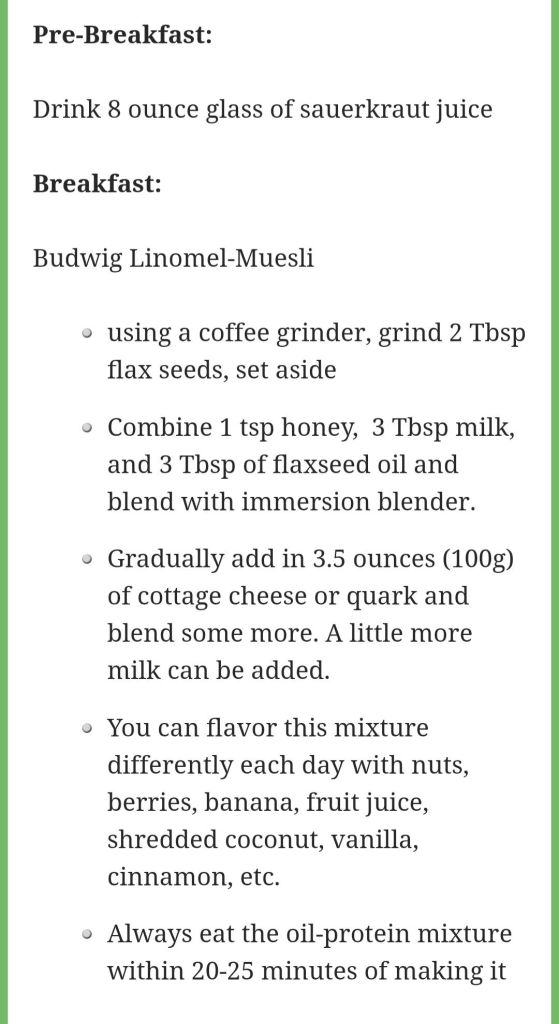
Came across this recipe, which promises cancer-fighting properties. It was developed by Johanna Budwig, a German biochemist and pharmacist who developed a lacto-vegetarian cancer prevention diet in the 1950s.
Not gonna lie, flaxseed oil tastes pretty yucky. It literally tastes like you are eating oil paint. BUT it contains a lot of omega 3 fatty acids, which most of us are not getting enough of.
Mixing with cottage cheese somehow helps aid in the digestion of the flaxseed oil. It has a symbiotic effect.
She passed away in 2003, a few years before the discovery of resolvins and protectins:
Only recently has it been established that inflammation resolution is an active process with a distinct set of chemical mediators. Several clinical and epidemiological studies have identified beneficial effects of polyunsaturated fatty acids (PUFAs) for a variety of inflammatory diseases, yet without mechanistic explanations for these beneficial effects. Resolvins and protectins are recently identified molecules that are generated from Omega-3 PUFA precursors and can orchestrate the timely resolution of inflammation in model systems.
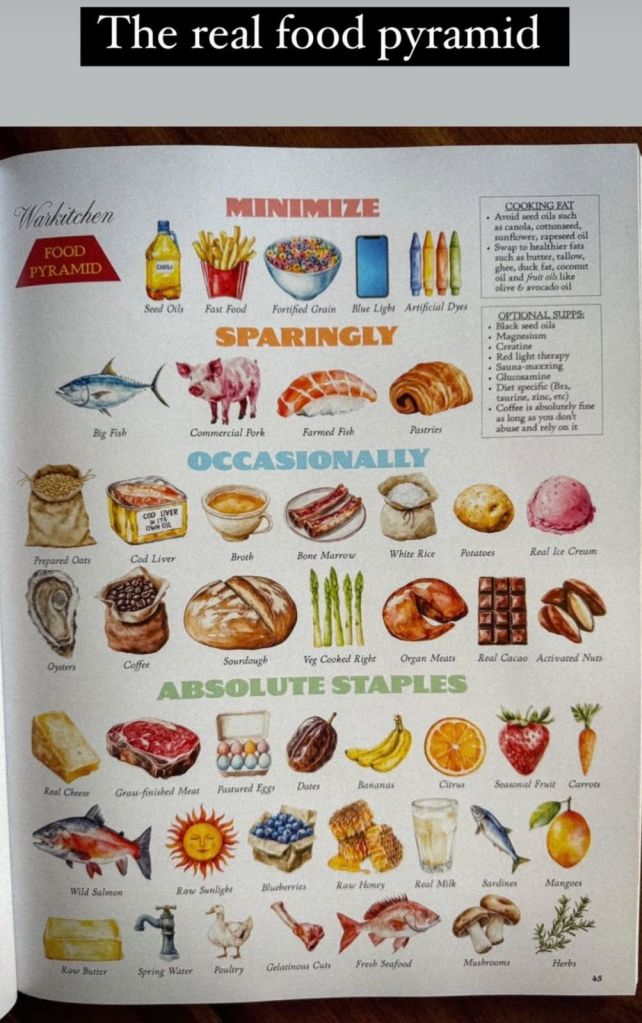
I do see this in relation to the seed oil info I posted earlier today. If modern man is living in an omega 3/ omega 6 imbalance, and we don’t know about it or understand the damage it is doing to us…. well, that’s a bad thing.
It’s interesting that Dr. Budwig’s daily regimen begins with sauerkraut juice… the kombucha of 1800s Germany.
Then she blends together flax seed oil (very high in omega 3s) with a dairy product to help it be absorbed easily.
I think the science will catch up to her and what she was able to do… reportedly nurse cancer patients back to health with nutritional strategies.
Stumbled across some great resources lately and I wanted to share them here. Thse were all serendipitous…
This doctor has a YouTube channel and provides very down-to-earth advice on how to stay healthy and avoid cancer. Check her out!
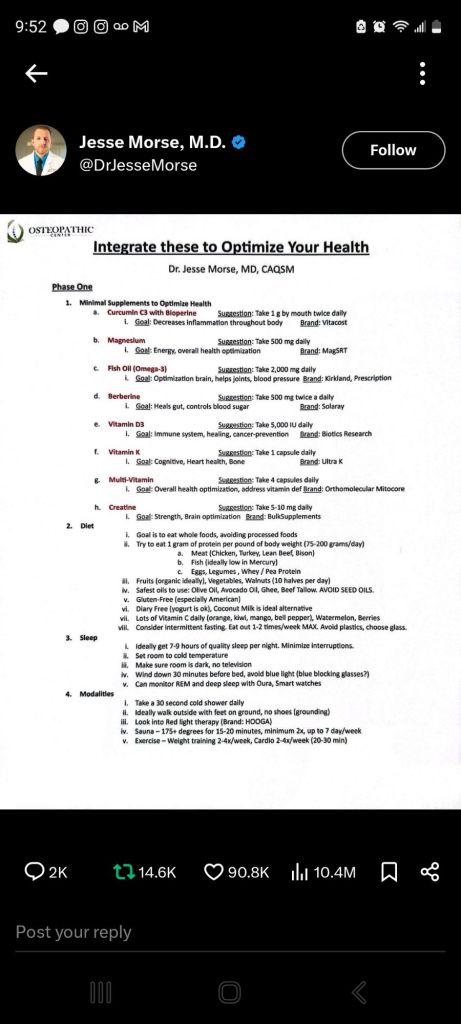
This doctor popped up in my Twitter feed, and I don’t know much about him, but WOW, I wish my doctor was handing out a sheet like this to his patients, including the healthy ones.
I have already incorporated a lot of these into my daily/weekly routines over the last year, and it’s great to have those ideas reinforced by a doctor.
The “seek” button on my car radio pulled up this radio show/podcast, which looks interesting. I happened upon their report of the Dirty Dozen and the Clean Fifteen:
Yesterday, the FDA banned Red 3 from foods and medicines.
While this is technically a good thing, its more of a baby step / half measure in the move toward a healthier society…
Why?
Red dye 3 was banned from cosmetic products 35 years ago because of its link to cancer. 35 years!!!
There are thousands of other additives that are just as toxic that are still being used in many foods, medicines, and other products. Most of these are banned in other countries.
This particular ban gives companies TWO YEARS to reformulate the food products. A lot can happen (or be reversed or forgotten about) in two years.
This ban gives pharmaceutical companies THREE YEARS to comply! Are you kidding???
It solves 0.01% of the problem with untested food additives.
The best thing this ban can do is simply awaken the consumer to the problem and lead them to change what they buy andeat.
Salads are so healthy, and I am lucky to have had them throughout my life as a regular part of the dinner meal, whether at my childhood home or my grandparents’ house.
It’s a tradition that my husband and I have kept going and one that I hope lives on as our kids make their own homes.
🥗
It was one of the first things I helped with as a child (one step up from setting the table). My Mom would tell me that a “true chef would never cut lettuce leaves with a knife” and would instead tear them gently. I’m not sure if that’s true, but it sounds right.
I’m sure she just didn’t want any little kids wielding a knife in her kitchen, lol.
Those salads usually included iceberg lettuce, tomatoes, and celery with a simple vinegar and oil dressing. Sometimes, we got fancy and added black olives or Spanish (manzanilla) olives.
And we always had the salad as the final course… the logic was that the roughage (fiber) and vinegar would escort all the other stuff from the night’s dinner through the system and do some clean-up work in the intestines.
Yes, we talked about this at the dinner table when I was too young to use a knife.
When we went to my grandparents’ house, the salad was similar but often included half an avocado. If half an avocado doesn’t sound like much to you, well… you must not have spent time in Florida prior to Hurricane Andrew. Those old style “Tampa avocados” were as big as a football.
If I had a time machine… that’s what I’d go get…
These days, I like to get fancy with my salads. I usually start with Romaine lettuce and tomato. Those are the basis.
To that, I add whatever we have, including fresh spinach, a shredded carrot, artichokes in vinegar, olives of any kind or a scoop of muffaletta, slices of sweet peppers, diced onion, mushrooms, cucumber, avocado, thinly sliced purple cabbage, celery, cheese (Feta or parmesagn), and any kind of sprout (broccoli, radish, alfalfa, etc.).
Sometimes, I throw in apple chunks, pear slices, or orange sections. Sometimes, we throw in sunflower seeds or crushed pistachios or cashews.
In the summer, I like to find new types of lettuce and new varieties of tomatoes at the farmers’ market.
My Nani had a trick where she would cut into a garlic clove and rub it on the inside of the bowl prior to adding any ingredients. I always seem to remember the trick too late. 😕
Lately, I’ve been moving my salad to the beginning of the meal, rather than the end. This is because of the hacks I recently learned to lower blood glucose levels.
Here’s the details on that, from the Glucose Goddess, Jessie Inchauspé who I hear just got her own TV show!!! 🙌

 The Cancer Canary