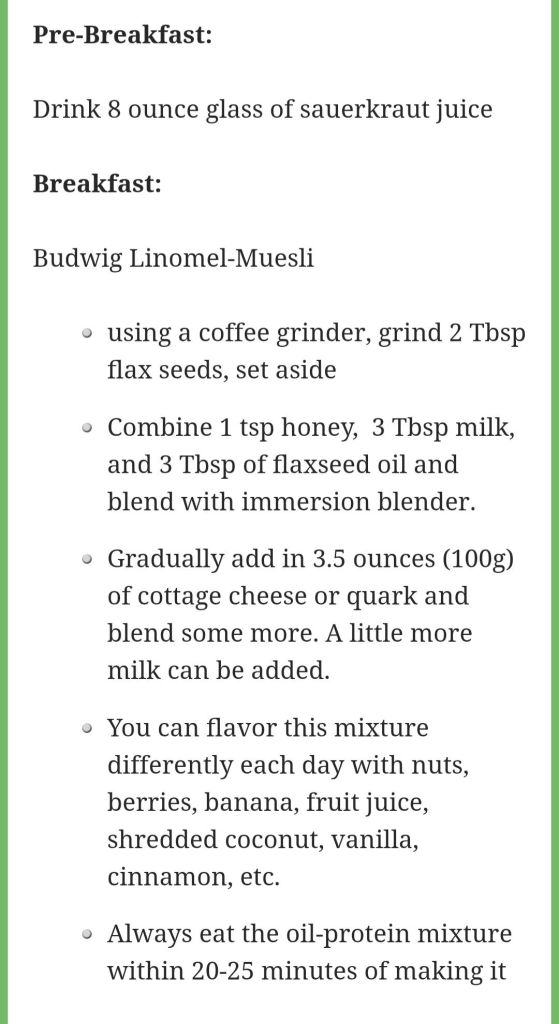
Came across this recipe, which promises cancer-fighting properties. It was developed by Johanna Budwig, a German biochemist and pharmacist who developed a lacto-vegetarian cancer prevention diet in the 1950s.
Not gonna lie, flaxseed oil tastes pretty yucky. It literally tastes like you are eating oil paint. BUT it contains a lot of omega 3 fatty acids, which most of us are not getting enough of.
Mixing with cottage cheese somehow helps aid in the digestion of the flaxseed oil. It has a symbiotic effect.
She passed away in 2003, a few years before the discovery of resolvins and protectins:
Only recently has it been established that inflammation resolution is an active process with a distinct set of chemical mediators. Several clinical and epidemiological studies have identified beneficial effects of polyunsaturated fatty acids (PUFAs) for a variety of inflammatory diseases, yet without mechanistic explanations for these beneficial effects. Resolvins and protectins are recently identified molecules that are generated from Omega-3 PUFA precursors and can orchestrate the timely resolution of inflammation in model systems.
I do see this in relation to the seed oil info I posted earlier today. If modern man is living in an omega 3/ omega 6 imbalance, and we don’t know about it or understand the damage it is doing to us…. well, that’s a bad thing.
It’s interesting that Dr. Budwig’s daily regimen begins with sauerkraut juice… the kombucha of 1800s Germany.
Then she blends together flax seed oil (very high in omega 3s) with a dairy product to help it be absorbed easily.
I think the science will catch up to her and what she was able to do… reportedly nurse cancer patients back to health with nutritional strategies.
I have wanted to write about this for a while but I’m a bit out of my depth, and so I’ve put it off… but it is critically important and the little that I know has really changed my eating habits.
I recently came across this Instagram post by Dr. Mark Hyman, which sums it up nicely.
I haven’t been writing much lately. There’s a slow and painful thing happening, and it feels wrong to write about it.
My sister-in-law is in hospice. She’s been fighting cancer for more than a dozen years. She’s done it all — surgeries, chemo, radiation, experimental drugs. She’s fought hard, dealt with debilitating side effects, and finally, her body is giving out.
It’s terrible.
What I want to say to you…
Ladies, pick up the phone and make an appointment for a mammogram and pap test.
Gentlemen, pick up the phone and get an appointment for a prostate exam. Do it.
Everyone over 45, get that colonoscopy booked. Put it on your calendar.
Everyone, no matter your age, book an appointment with a dermatologist. Get checked scalp to toes. Your skin is your largest organ! Don’t overlook it!
No matter your age, get a full blood workup. See if anything is out of normal ranges. Check your fasting glucose (and plan to actually fast before getting the test). Ask for the hemoglobin A1C test and check that level — it’s so important to get a feel for your metabolic health. See my blog Are You Metabolically Healthy? to help understand the findings.
If you smoke or did in the past, talk to your provider about the low-dose CT scan for lung cancer. More info in my blog Stamp Out Lung Cancer.
Many cancers are treatable if caught early. If you have medical insurance, these screenings will be fully or mostly covered.
Finally, check yourself. Are there any lumps? Check your neck, throat, etc. Are there any spots on your skin? A weird mole, perhaps? Are you feeling easily winded or tired after light exercise? Does your sweat smell different? Are you shaky when you miss a meal? Unexplained headaches? Notice these little signals and discuss with your doctor.
Please don’t delay. ❤️ Your health and life are precious.
As more and more physicians begin to understand the correlation between mitochondrial dysfunction and diseases such as cancer (and diabetes and dementia, and possibly others), I’m positive that some good things will happen.
One exciting thing is that, with the use of continuous glucose monitors, more and more people are able to see how their food choices impact this process, and then make better food choices.
Another exciting thing is that people are becoming aware of the issue and switching to ketogenic diets, which could reverse diabetes or manage (slow) the progression of cancer.
A new theory of cancer origin was recently introduced. It’s called the mitochondrial-stem cell connection (MSCC) (Martinez, et al., 2024). It builds on two other theories: Dr. Seyfried’s metabolic theory and the cancer stem cell (CSC) theory. I’ll put a link at the bottom if you want to learn more about that. I should mention that Dominic D’Augustino is one of the “et al.”
The exciting thing about this paper recently published on MSCC is that it proposes FIXING the underlying issue rather than focusing on killing cancerous cells.
In the past, most cancer therapies were built on the notion that cancer was genetic… it happened to those who were genetically predisposed to it… and the assumption was that to fight it meant to kill the cells, cut them out, radiate them, etc.
You could say that current cancer treatments are like playing whack-a-mole in an arcade. This new paper suggests we stop wracking the moles and simply unplug the machine from the wall.
Here are some excerpts. I will link the full paper below.
● This connection between CSCs and mitochondria appears to be crucial at all stages of cancer (Martinez, et al., 2024).
● These (standard) therapies do not restore OxPhos and sometimes even alter it (Averbeck & Rodriguez-Lafrasse, 2021; Gorini, et al., 2018). Furthermore, standard therapies only target bulk cells but cannot target cancer stem cells (Lytle, et al., 2018), whereas it is cancer stem cells that have the strongest tumorigenic potential (Adams & Strasser, 2008) and are involved in metastasis.
● Thus, after reviewing the literature on various therapies capable of targeting the MSCC, we selected, based on in vitro and in vivo studies, several orthomolecules, drugs, and additional therapies that have demonstrated an ability to enhance OxPhos, reduce fermentable fuels, and target CSCs and metastasis. Furthermore, when supported by scientific literature, we included case studies of cures using monotherapy in humans. From this combination, we developed a hybrid orthomolecular protocol, which is proposed as a new therapeutic strategy for cancer.
• The degree of malignancy could be directly correlated with significantly lower mitochondria and lower total respiratory capacity in tumor cells (Elliott, et al., 2012; Pedersen, 1978; Seyfried, et al. 2020).
• In order to grow and survive, cancer cells require the primary fuels glucose and glutamine to compensate for OxPhos insufficiency. The respiratory impairment induces overexpression of oncogenes and inactivation of tumor-suppressor genes, which contribute to abnormal energy metabolism in cancer. To date, no evidence has demonstrated the growth of any tumor cells, including CSCs, occurs with the deprivation of fermentable fuels (glucose, pyruvate, or glutamine) (Lee, et al., 2024; Liao, et al., 2017; Holm, et al., 1995; Mathews, et al., 2014; Pastò, et al., 2014).
And what does it have to do with cancer, or therisk of cancer?
There have been many theories about how cancer originates in the body.
Dr. Thomas Seyfried of Boston College published the theory that cancer begins with chronic metabolic dysfunction — that is, mitochondria within a cell not being able to create good energy for a prolonged period of time — which causes them to begin creating energy through a fermentation process rather than through oxidative phosphorylation, often called OxPhos (Seyfried & Chinopoulos, 2021).
This is the key difference between healthy cells and cancerous cells: healthy cells use oxygen to create energy, while cancerous cells have reverted to an easier, ancient way to create energy (possibly from before Earth had a proper atmosphere) through fermentation of glucose (sugar) and an amino acid called glutamine.
This difference in mitochondrial function links all cancers together, regardless of which organ it appears within.
We have known this for a while. Did you know that PET scans, widely used to seek out and image cancerous activity in the body, are taken after a person ingests a sugary dye? The sugar (glucose) goes straight to the hungry cancer cells, carrying the dye that is visible to the scanner.
Why does mitochondrial dysfunction happen?
One reason why mitochondrial dysfunction happens is simply the presence of too much sugar and simple carbohydrates in a person’s diet.
These need very little digestive breakdown and go straight to the mitochondria as glucose molecules.
The mitochondria become overwhelmed with the amount of glucose they are being asked to process. They bog down and ask for help from the pancreas and insulin. They push the remaining glucose out into the blood as a sticky residue.
Have you ever felt tired, sluggish, and slow after a big meal or too many carbs? Food coma?? That is an indication that your cells are overwhelmed. You’re in a glucose storm, and your body is suffering.
This leftover glucose in the blood sticks to your hemoglobin, or red blood cells. This is the residue measured by a Hemoglobin A1C test.
I’m having lots of Eye of Sauronmoments as I learn more about glucose, metabolic disease, and metabolic dysfunction. It’s not pretty, and at times, I’m in tears, thinking about signs of bad health I missed over the years.
Recently, I saw my general practitioner (Dr. Laura). I knew there would be some bloodwork involved.
For the first time in my life, I deliberately fasted, even skipping my regular black coffee that morning so that I could get a true fasting glucose level.
What’s considered normal? The normal range for fasting glucose is from 60 to 100 mg/dL.
For the last few years, I’ve tested on the higher side of normal (between 93 and 99), but as I said, its the “fasting glucose” they are measuring, and I’ve never done bloodwork when fasting.
It’s never been articulated to me that I really should fast before bloodwork. No one has ever said, “When was the last time you ate or drank anything other than water?” Neither a doctor nor the phlebotomist, as they get ready to take my blood sample.
It wasn’t until 2023 that ANY doctor looked at my glucose level and said, “That’s high. You should pay attention to your sugar intake.”
(And that’s when I quit Cheerios, months before getting diagnosed with CLL.)
But of course, our health is in our own hands. It was probably right there in 6 point light gray type on the back of the form.
So, back to the present. Last week, I was thrilled to see that my fasting glucose was 88! Wow!! I’m fixing my metabolism! I patted myself on the back.
Dr. Laura decided to also do a hemoglobin A1C test, which took a few days longer to show up in my chart. I’ve never had one before. The CDC currently recommends that everyone over 45 should have one, and that anyone who is overweight or showing signs of diabetes should have one, regardless of age.
Well, my results show that I’m just over the top range at 5.8%, which is pre-diabetic.
What’s considered normal? The normal range for hemoglobin A1Cis between 4.2% and 5.6%. The diabetic range begins at 6.4%.
So, yeah. That took a few days to digest. I do struggle with this news because I have eliminated ALL processed foods and sugars from my diet for over a year now. Even before that, I rarely drank a soda or any type of alcohol. I would have described my diet as healthy.
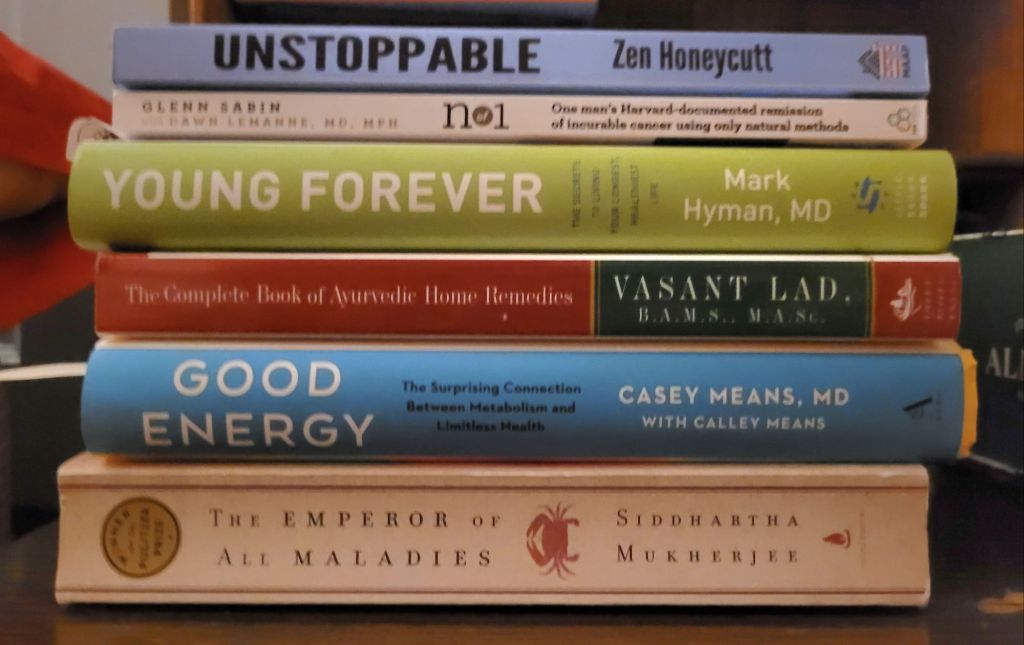
I’ve been reading Good Energy by Dr. Casey Means, and I remembered a section on these sorts of metabolic biomarkers.
I found and re-read those pages. She calls for lower averages on almost all of the metabolic markers than the current standards.
Here’s how she starts: “… we have all nodded as doctors quickly glossed over test results, but very few of us have any idea what these numbers mean.”
Boy, howdy!
She defines “fasting” as 8 hours without eating or drinking any calories and sets a range of 70 to 85 mg/dL as the optimal range for fasting glucose.
She also lists 5.0% to 5.4% as the lowest risk range for hemoglobin A1C.
So, beyond sugars and processed foods, the next thing I need to look at is my carb intake. That’s the potatoes, pasta, rice, oats, and other grains that make up so much of our diet.
Good luck to me (and all of us) on Thanksgiving! Gobble gobble!
I also found this episode on one of my favorite podcasts, Diary of a CEO.
The Glucose Goddess, Jessie Inchauspé, has so much to teach us!
She told a quick story about a man who read her book. “There was this one guy, he had diabetes his whole life, he’s in his 50s, on lots of medications, and just thought he would lose a leg, or lose his vision… that’s what happens when you have type 2 for a very long time… and his doctors had never explained to him WHY he had diabetes, they had just told him ‘take this pill’ and ‘take this insulin’… and, he read my book, and he understood why he got diabetes in the first place, and he did the hacks. He was able to reverse his type 2 diabetes in one year. All his doctors were like, “How did you do it?” … you know, doctors don’t often have this information…”
Here are a few positive steps or “hacks” shared in the episode:
Eat a savory breakfast. This means eating protein, fats, and NOTHING sweet. (She suggests eggs, meat, tofu, nuts, and dairy, or leftovers from dinner). When you have sweets for breakfast, she warns, you set yourself up for a day of sugar spikes and crashes.
Vinegar once a day. 1 tablespoon in a glass of water 10 minutes before your biggest meal. It interacts with your digestive enzymes and keeps you from having a glucose spike. Dilute it with water so it doesn’t hurt tooth enamel.
Veggie starters are vegetables eaten at the beginning of a meal. This puts fiber into your intestines before the rest of the meal, slowing the absorption of glucose into your system. Combine with hack 2 for a pre-meal salad.
Exercise after eating. Just light activity is fine. Walk the dog. 10 minutes is all it takes. Calf muscles soak up glucose more than any other muscle in the body.
I’m off to get a copy of her book to add to my nightstand collection. 📖
Dr. Casey Means uses these five key biomarkers to determine if a person is metabolically healthy. Do you make the cut?
An HDL level above 50 for women or above 40 for men. HDL stands for high-density lipoprotein.
A fasting glucose level of under 100 milligrams per deciliter.
A triglyceride level of less than 150 milligrams per deciliter.
Blood pressure under 120/85.
A waist circumference of less than 35 inches for women and less than 40 inches for men.
Dr. Means cites research that indicates that approximately 93% of adults are not metabolically healthy, which lays the groundwork for a variety of health problems, including diabetes, heart disease, dementia, and cancer.
Strangely, according to these markers, I’m actually in a healthy range … cancer and all. 🤔
These are the notes I took while reading Good Energy and watching Dr. Casey Means discuss her new plan for optimally healthy meals.
She (and many other doctors and nutritionists) wants us to ditch the food pyramid, which pushed carbs as the staple food, and move to something like this 5-slice pie above.
If we could design each meal to include one element from each section, we would be healthier in terms of our mitochondrial function.
I put it on the fridge so I see it every day, at every meal.
I used to have tummy troubles all the time. ALL the time.
I was embarrassed to see a doctor about it. I minimized the issue and told myself it made sense that I had tummy troubles since many other people in my family also have this issue.
I dealt with it through restricting my diet, thinking that if I cut out the triggering food, things would stay on an even keel. (Now I wonder if the trigger was actually glyphosate).
Last year, we had a fish fry that really did a number on me. I was so worn out the next day that I tried something new: kombucha.
Overnight, everything changed. I’m happy to say that my stomach is very regular now.
I usually keep 1 or 2 bottles in the fridge and drink a “shot” or teacup-full after dinner. Once in a while, I’ll drink an entire bottle. It’s pretty high in sugar, so I try to go light on the amount in one serving.
I could kick myself for not trying it sooner, for not doing the research and figuring it out sooner. I could kick myself for continuing to suffer for so long. For decades.
Knowing what I know now, I wonder if this was the vulnerability in my particular system, which “let in the bad.”
Allowed prolonged mitochondrial dysfunction.
Let in the cancer.
Sigh.
Well, I can’t go back, but I can tell you: If you have tummy troubles, seek out some fermented foods.
Kefir
Saurkraut
Fermented pickles
Kombucha
Yogurt with active cultures
Kimchi
There’s a wonderful doctor you can find on YouTube named Dr. Will Bulsiewicz. He’s the gastro doctor you never knew (or admitted) you needed.
One of the first things you realize after getting diagnosed is that, unfortunately, everybody’s got something going on.
A friend of mine has Myasthenia Gravis. She just finished chemo for throat cancer. Now they’ve found a new cancer.
A neighbor is mourning the sudden loss of her husband.
A friend’s son just got married to a girl who had beaten cancer once. Now it’s back (they’re only 25!!! 😫).
Two of my coworkers have diabetes. Another just had to have her gall bladder removed. They are all younger than me (and it’s a small company, maybe 25 employees).
People used to say that “1 out of 4” people would have cancer during their lifetime. Now the rates are 1 out of every 2 men (50% 😵💫) and 1 out of every 3 women (33%), at least in developed countries. (In places where people eat traditional foods, the rates are much lower.)
So yeah, I’m not special. I’m just one of the gang now. The CLL gang. The cancer gang. The chronic disease gang. Dammit.
Really hoping that we reach a tipping point soon, though. A point where the average person gets angry and wants answers and results and change. Not ribbons and awareness, not a fun run, but actual results.
Maybe we could demand that farms stop spraying glyphosate.



 The Cancer Canary