
Listen to the Glucose Goddess explain why its beneficial to eat your food in the right order:
Tag: sugar
The Warburg Effect
This video is already three years old, but worth a watch:
The Warburg Effect is the basis of the research into the new(ish) theories around treating cancer as a metabolic disease, as well as much of the research on fasting and its benefits.
Pleased to Meet You
Hope you guess my name.
We’ve all heard that Rolling Stones song a million times: Sympathy for the Devil.
Today’s post is about sugar — and all the names that particular devil hides behind. Take a look … then go look at the ingredients panel on a few items in your kitchen.
● Agave juice
● Agave nectar
● Agave syrup
● Beet sugar
● Blackstrap molasses
● Brown rice syrup
● Brown sugar
● Buttered syrup
● Cane juice
● Cane juice crystals
● Cane sugar
● Cane syrup
● Caramel
● Carob syrup
● Castor sugar
● Coconut sugar
● Confectioners’ sugar
● Corn glucose syrup
● Corn syrup
● Corn syrup solids
● Crystalline fructose
● Date sugar/syrup
● Demerara sugar
● Dextrose
● Drimol
● Ethyl maltol
● Evaporated cane juice
● Flo malt
● Florida crystals
● Fructose
● Fructose corn syrup
● Fructose syrup
● Fructose sweetener
● Fruit fructose
● Fruit juice
● Fruit juice concentrates
● Glucose
● Glucose solids
● Glucose syrup
● Golden sugar
● Golden syrup
● Granular sweetener
● Granulated sugar
● Grape sugar
● High fructose corn syrup
● Honey
● Honibake
● Icing sugar
● Inverted sugar
● Isoglucose
● Isomaltulose
● Kona-ame
● Maize syrup
● Malt syrup
● Maltodextrin
● Maltose
● Maple
● Maple sugar
● Maple syrup
● Mizu-ame
● Molasses
● Muscovado sugar
● Nulomoline
● Panela sugar
● Powdered sugar
● Raw sugar
● Refiner’s syrup
● Rice syrup
● Sorghum syrup
● Starch sweetener
● Sucanat
● Sucrovert
● Sugar beet
● Treacle or treacle sugar
● Turbinado sugar
● Unrefined sugar
● Yellow sugar
Sugar Alcohols:
● Erythritol
● Hydrogenated starch hydrolysates
● Isomalt
● Lactitol
● Maltitol
● Mannitol
● Sorbitol
● Xylitol
Puzzlin’ you is the nature of my game!
What’s So Bad About Sugar, Anyway?
And what does it have to do with cancer, or the risk of cancer?
There have been many theories about how cancer originates in the body.
Dr. Thomas Seyfried of Boston College published the theory that cancer begins with chronic metabolic dysfunction — that is, mitochondria within a cell not being able to create good energy for a prolonged period of time — which causes them to begin creating energy through a fermentation process rather than through oxidative phosphorylation, often called OxPhos (Seyfried & Chinopoulos, 2021).
This is the key difference between healthy cells and cancerous cells: healthy cells use oxygen to create energy, while cancerous cells have reverted to an easier, ancient way to create energy (possibly from before Earth had a proper atmosphere) through fermentation of glucose (sugar) and an amino acid called glutamine.
This difference in mitochondrial function links all cancers together, regardless of which organ it appears within.
We have known this for a while. Did you know that PET scans, widely used to seek out and image cancerous activity in the body, are taken after a person ingests a sugary dye? The sugar (glucose) goes straight to the hungry cancer cells, carrying the dye that is visible to the scanner.
Why does mitochondrial dysfunction happen?
One reason why mitochondrial dysfunction happens is simply the presence of too much sugar and simple carbohydrates in a person’s diet.
These need very little digestive breakdown and go straight to the mitochondria as glucose molecules.
The mitochondria become overwhelmed with the amount of glucose they are being asked to process. They bog down and ask for help from the pancreas and insulin. They push the remaining glucose out into the blood as a sticky residue.
Have you ever felt tired, sluggish, and slow after a big meal or too many carbs? Food coma?? That is an indication that your cells are overwhelmed. You’re in a glucose storm, and your body is suffering.
This leftover glucose in the blood sticks to your hemoglobin, or red blood cells. This is the residue measured by a Hemoglobin A1C test.
Comparison Shopping
Was doing some grocery shopping this morning, and I needed kombucha.
Take a look at these three products.
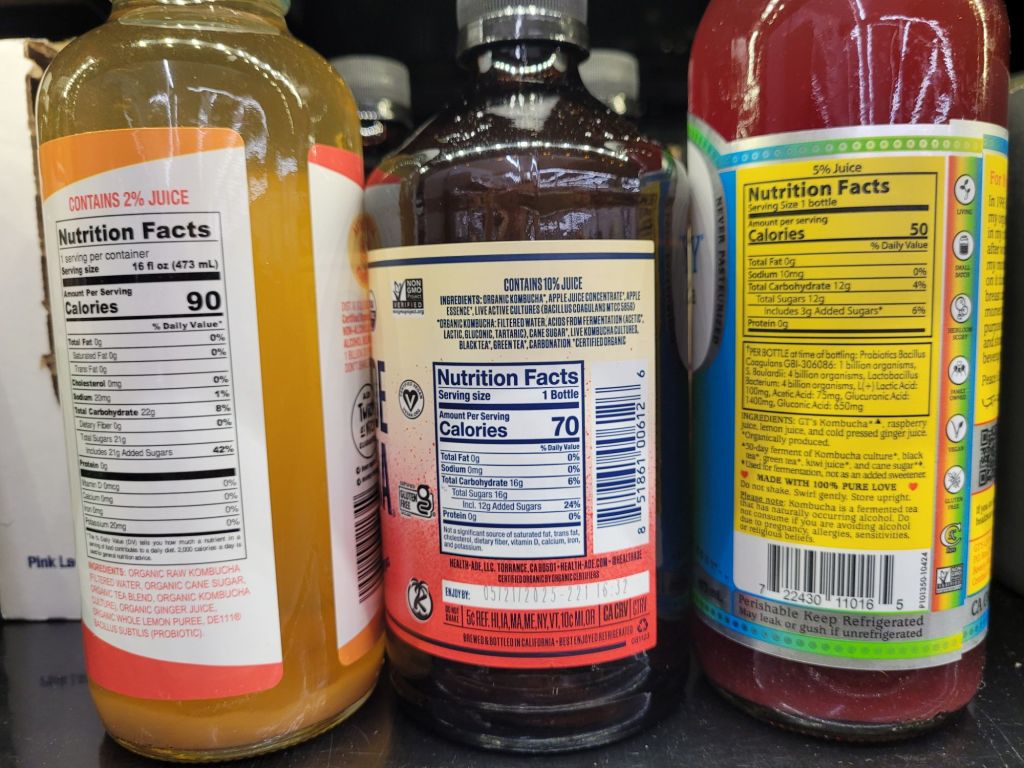
I usually just drink a shot in the evenings… but if I were to drink the entire bottle…
The brand on the left would give me 42% of my recommended daily allowance of sugar.
The middle brand has 24% of the RDA of sugar.
The brand on the right has 6% of the RDA of sugar.
That’s a big difference! It’s definitely worth taking the time to look.
 The Cancer Canary